

Estimated reading time: 9 minutes
Table of contents
- The Short Answer
- Stage-by-Stage: What Actually Happens and How Long Each Step Takes
- 1. Reporting the Injury (Immediate)
- 2. Initial Medical Treatment (Days to Weeks)
- 3. Temporary Disability Benefits (Ongoing During Treatment)
- 4. Reaching “Maximum Medical Improvement” (Months to a Year or More)
- 5. Evaluation and Settlement Negotiation (One to Six Months)
- 6. Formal Hearing or Trial (If Contested – Add Six Months to Two Years)
- Local Factors That Affect Your Case’s Timeline in New Jersey
- What Can Slow Your Case Down
- What Can Help Move Your Case Along
- Why the Timeline Is Worth Getting Right, Not Just Fast
- Frequently Asked Questions
- Talk to a New Jersey Workers’ Compensation Attorney
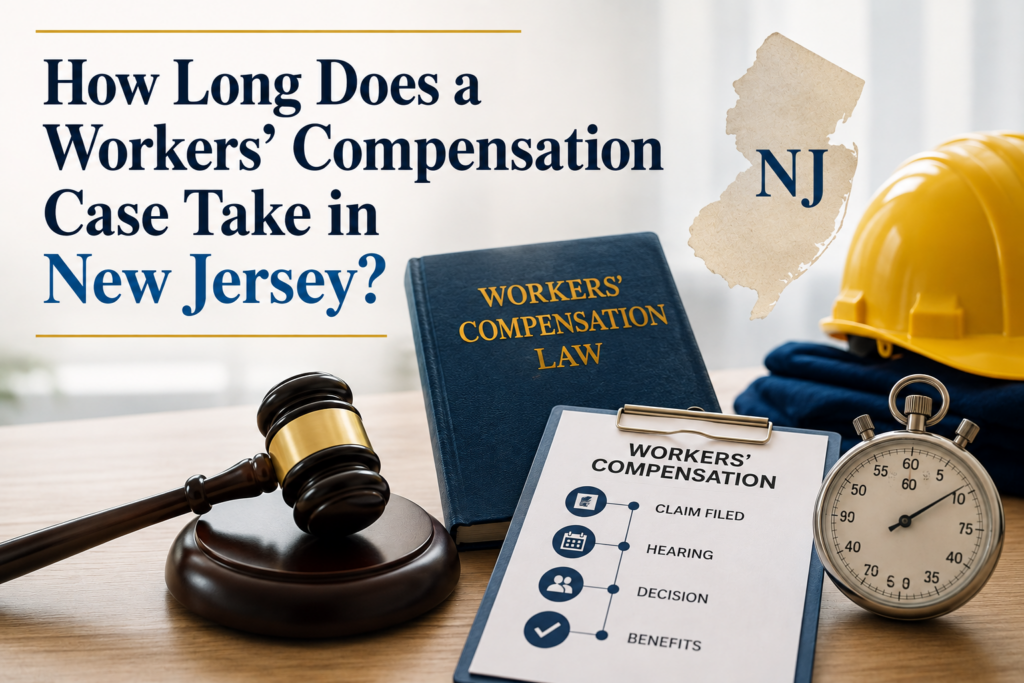
For individuals who have sustained injury on the job, in New Jersey, one of the most pertinent questions is: how long will it take? Each workers’ compensation case can vary from several months for straightforward claims, to one year or longer for cases that are contested and are required to proceed as a trial before a Workers’ Compensation Judge.
Our experienced New Jersey workers compensation lawyers, Pellettieri Rabstein & Altman, have been successfully guiding the injured workers of New Jersey through the complicated New Jersey workers compensation system for almost 100 years. In this article, we will take you through a step by step look at the typical process that is involved in processing a workers compensation claim.
The Short Answer
An uncontested case with a very cooperative employer and insurance carrier can be settled within a few months to six months. On the other hand, a contested case (i.e. the insurance company claims that the worker was not injured at work, that the work injury was not as serious as claimed, or that the worker is not entitled to continue treatment) can take a year or more to resolve, depending on whether a trial is required.
So when people ask how long does a workers’ compensation case take in NJ, the answer is that it depends on a few things including whether or not the case is contested, the development of the medical evidence and the backlog of cases at the specific Division of Workers’ Compensation hearing the case.
Stage-by-Stage: What Actually Happens and How Long Each Step Takes
1. Reporting the Injury (Immediate)
The laws of New Jersey require that the injured party notify their employer of the work related injury as soon as is practical. The employer then reports the injury to its workers’ compensation insurance carrier. Such reporting is to take place within days, and any failure to report by the employer, and any subsequent failure by the supervisor to report the injury and file the required report can negatively impact the resultant timeline for the injured party.
2. Initial Medical Treatment (Days to Weeks)
After a claim has been reported for a work injury, the insurance carrier will usually authorize the injured worker to go to a physician chosen by the carrier. If the carrier has accepted the claim for benefits promptly, the injured worker should receive treatment within a week or so. However, if the carrier has begun to dispute the claim for benefits from the start, it can take months for the attorney to compel the carrier to authorize treatment for the injured worker.
3. Temporary Disability Benefits (Ongoing During Treatment)
If you are disabled for more than seven days from work, you are entitled to temporary total disability benefits. These are paid at the rate of 70% of your average weekly wage, up to a maximum determined by the State. The worker is entitled to continue receipt of these benefits for the duration of their treatment for the work-related injury, and during their period of recovery from such injury.
4. Reaching “Maximum Medical Improvement” (Months to a Year or More)
Your case will typically not be ready for resolution until your treating physician determines you have reached Maximum Medical Improvement (MMI). This is the point at which your physician determines that you have reached the highest level of medical improvement, even if you are not completely recovered from your injury. As a general rule, a broken bone will reach MMI in a few months, but a spinal injury, repetitive stress injury, or a case with multiple surgeries can take a year or longer to reach MMI.
5. Evaluation and Settlement Negotiation (One to Six Months)
Your attorney will then negotiate with the workers’ compensation insurance carrier for the value of your claim. The length of time to reach a settlement for a workers’ compensation claim varies. Typically, simple cases with adequate documentation of your work injury can settle within a few months. Disputed disability ratings and complicated issues involving pre-existing medical conditions can take considerably longer to settle.
6. Formal Hearing or Trial (If Contested – Add Six Months to Two Years)
Since negotiations didn’t result in a fair settlement, the matter will proceed to a formal hearing before a Workers’ Compensation Judge in the Division of Workers’ Compensation. At the hearing, both parties will present evidence, including discovery, and the testimony of expert medical witnesses. Given the current caseload of the Workers’ Compensation Courts in New Jersey, a contested matter that proceeds to a trial can easily add one to two years to the timeline outlined above.
Local Factors That Affect Your Case’s Timeline in New Jersey
There are many district offices throughout New Jersey where a case can be held. Pellettieri Rabstein & Altman represents injured workers in cases filed in district offices throughout New Jersey. The following list represents some of the vicinages or district offices where cases are held:
- Trenton and Lawrence Township – cases filed through the Mercer County-area
- Cherry Hill and the greater South Jersey/Camden County area
- Morristown and Morris County
- Nutley and the northern New Jersey/Essex County corridor
An experienced workers’ compensation Attorney, who regularly appears before the Judges in your District Office, has knowledge of realistic time frames for processing of a claim as well as information regarding how a particular office handles scheduling of hearings, granting of adjournments and settlement conferences.
In addition to being a state with high rates of workplace injury, New Jersey is home to a large number of unionized workers in manufacturing, warehousing, healthcare and construction jobs. As a result, many of the cases that Pellettieri Rabstein & Altman handles are those of tradespeople, state and county workers, construction workers, service employees and factory workers. Due to the nature of their injuries, which can be repetitive stress in nature, their cases can take longer to document and resolve than those that involve single traumatic events with clear causes of injury.
What Can Slow Your Case Down
- A denied or disputed claim: Such a claim would typically be denied by the insurance carrier in question and then litigated by the injured worker in dispute of said denial, typically resulting in a substantial delay in the process.
- Disputes over selection of doctor: Authorizing treatment through the wrong channel can lead to denied bills and treatment being postponed.
- Missing the reopener window: Claims can be reopened if an injured worker’s condition worsens but only within two years from the last payment of benefits, typically.
- Incomplete medical documentation: Work-related injuries with incomplete or insufficient documentation, especially where there are gaps in treatment or inconsistent medical records will generate significant delay and possibly lead to the denial or dispute of a claim.
- Pre-existing condition disputes: If an injured worker has a prior injury to the same body part as the work injury, expect the insurance carrier to scrutinize the work injury claim for denials or delays in payment of benefits.
What Can Help Move Your Case Along
- Notify your employer of the injury as soon as possible, preferably in writing.
- Attend every authorized medical appointment and follow your treatment plan.
- Keep copies of any medical records, correspondence, or pay stubs that you receive.
- Be sure to respond in a timely fashion to any requests for information from your attorney or from the insurance company.
- Get an experienced workers’ compensation Attorney on your case early on before a dispute arises.
Why the Timeline Is Worth Getting Right, Not Just Fast
It’s natural to want to resolve matters as quickly as possible when not working and being bombarded with bills. However, it’s crucial to wait until you have reached the point of maximum medical improvement, or learned the full extent of any permanent injury, in order to obtain the maximum amount of value for your claim. The attorneys at our firm will work to resolve matters in a timely fashion, yet ensure that our clients are receiving the maximum amount of value for their claims.
Frequently Asked Questions
Q: How long will a NJ workers compensation case take to settle for an uncontested claim?
A: You can expect to receive treatment within a few days to weeks, and can expect to have your claim settled within 6 months to a year after you reach maximum medical improvement and have completed all necessary treatment.
Q: How long does a workers’ compensation case take in NJ if it’s contested?
A: As mentioned before a contested case can take anywhere from one to two years and on occasion longer if the matter has to be tried before a Workers’ Compensation Judge.
Q: Can I speed up my workers’ compensation case?
A: No, generally not. Workers’ compensation cases cannot be rushed beyond the natural progression of a worker’s medical treatment and their reaching of maximum medical improvement (MMI). However, there are steps that a worker can take to ensure that their case is processed in a timely manner and does not suffer from unnecessary delay. Here are a few suggestions. First, report your injury to your employer as soon as possible. Second, attend all authorized medical treatments. Third, keep a record of all contacts with your employer, the insurance company, and your attorney. Lastly, hire an attorney early on. An experienced workers’ compensation attorney can handle any disputes that arise during the course of a claim and can ensure that your claim is processed in a timely manner.
Q: Does hiring a lawyer for a workers’ compensation case make the case take longer?
A: No, in fact just the opposite. An attorney who is experienced in workers’ compensation can help make sure all the proper paperwork is completed on time and can help settle any disputes that arise in a timely fashion.
Q: Can I extend the closing of my workers’ compensation case after it is closed if my condition worsens?
A: A party may seek a Reopener of a closed case within two years of the date of the last payment of compensation if the injury worsens. Note, a Reopener is a separate claim from the original claim.
Q: Do I need to live near one of PR&A’s offices to work with the firm?
A: No, all of the injured workers that Pellettieri Rabstein & Altman represents are throughout New Jersey, including from Lawrence Township, Cherry Hill, Morristown, Nutley and in Trenton.
Talk to a New Jersey Workers’ Compensation Attorney
Every workers’ compensation case moves at its own pace. You don’t have to go through the process by yourself and wonder what’s happening with your claim. The attorneys at Pellettieri Rabstein & Altman are certified workers’ compensation attorneys by the New Jersey Supreme Court. We work on a contingency fee basis, therefore there is no upfront cost to have your questions answered as to the current status of your case.
Call us toll-free at 800-432-5297 to speak with an attorney regarding your workers’ compensation claim. You can also fill out our online form for a free consultation.


