

Estimated reading time: 10 minutes
Table of contents
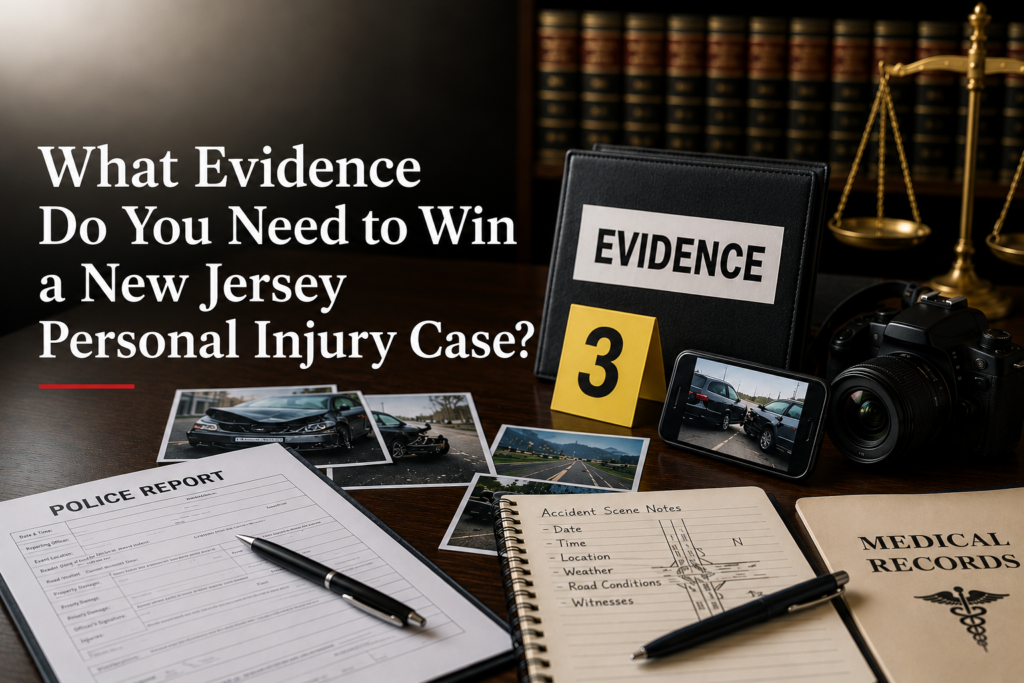
The extent of your injuries does not necessarily determine the merit of your claim for personal injury. What will determine the merit of your claim for personal injury is the evidence you have to support your claim for damages. Insurance companies and defense attorneys do not care how badly you were hurt. They care only about the personal injury evidence that you can provide to prove your claim for damages in accordance with the personal injury evidence required by the New Jersey courts.
The personal injury lawyers at Pellettieri Rabstein & Altman represent individuals injured in accidents throughout Mercer County, Camden County, Essex County, Morris County and the rest of New Jersey. Below we explain what is required for personal injury evidence, how to prove negligence in a New Jersey court, and what to expect in a New Jersey personal injury lawsuit.
Why Evidence Matters More Than the Injury Itself
In New Jersey, the state follows a negligence standard which means that in order to recover for injury or damages, you must prove four key elements of negligence:
- Duty
- Breach
- Causation
- Damages
If you fail to prove any one of these four elements, even the most serious injury may not give rise to a successful claim for compensation. Whether the claim stems from a car accident, slip and fall, work injury or other type of premises liability accident, the same four elements of negligence must be proven.
Each of the four elements required to prove a negligence claim in New Jersey must be proven with separate evidence. For example, proof of duty will show the obligation that the defendant owed to the injured party. A property owner has a duty to keep walkways under his control in good repair and maintenance free of hazards. Proof of breach will show how the defendant failed to meet the standard of care required by his duty. In a car accident, for example, a driver was speeding or failed to yield the right of way to another driver. In a slip and fall case, a customer slipped on a spill in a store and the store failed to clean it up in a reasonable time.
In a workplace injury or a premises liability case, an employee was injured when he fell through a broken or rotten out railing or wall. The next element, causation, is typically the most difficult to prove in a negligence case. Many people are injured and the insurance company claims that the injury was caused by something else. For example, an insurance company may claim that a pre-existing condition caused an injury or that another event caused the injury or that the injured person’s actions caused his or her own injury. The final element, damages, must be shown with proof of the amount of damages incurred by the injured party. This can include proof of medical bills, lost wages and pain and suffering.
It is not sufficient for an injured person to tell of an incident and claim injury in order for an insurance company to settle a claim. There are many incidents in which people are injured, and the insurance company has every intention of paying nothing for the person’s injury. In order for a claim to be supported, there must be evidence that proves liability for the injury. When a claim is supported by photographs, medical records and reports, expert analysis and other documentation of evidence that prove liability for an injury, then an insurance company has very little room to negotiate a fair settlement for the injury. In most cases, the insurance company will agree to a fair settlement in order to avoid the cost of litigation.
Because the party injured in an accident carries the burden of proof to establish a claim for damages, it is essential that evidence is gathered as soon as possible and preserved in the best possible condition.
- Skid marks on the road where an accident occurred can fade in a matter of days.
- Video surveillance at stores, offices and other locations where accidents can occur is typically overwritten in a matter of two weeks.
- Witnesses to accidents often move from the area and can be difficult to locate.
- Human memory is also not as reliable as physical evidence and can deteriorate over time.
- A defective product or hazardous condition that caused an accident can often be repaired, removed and even discarded by the business or property owner who is responsible for the accident prior to a claim being filed.
The sooner the evidence in support of a personal injury claim is gathered and documented, the stronger your position will be in your negotiations with the insurance company of the party responsible for your injuries as well as in court before a jury.
The Core Categories of Personal Injury Evidence NJ Claims Require
1. Accident and Incident Reports – The police report for a car accident, a fall at a store or other property, or an work place injury will provide a detailed description of the accident including a preliminary assessment of fault. Incident reports also include the names and contact information for any witnesses as well as descriptions of the surroundings at the time of the incident including the weather and any other relevant information. OSHA reports are also typically completed for workplace injuries.
2. Photographs and Video – The photos taken at the scene of the car accident, as well as any photos of injuries, can be used as strong evidence to prove a personal injury claim NJ. In addition, any surveillance video from nearby stores, traffic cameras, and even dash cams can be critical in proving fault for an accident. However, this type of video evidence is frequently deleted within days to weeks of an accident, therefore it is very important to send out a preservation letter as quickly as possible.
3. Medical Records and Bills – These documents can establish the severity of your injuries and relate your treatment to the incident that caused them. Your emergency room records, X-rays and MRI’s, physical therapy notes, and specialist’s evaluations all list your injuries in detail and list the cost of your medical care. If you don’t continue your recommended course of treatment, the defendant can argue that your injuries weren’t that serious.
4. Witness Statements – The accounts of independent witnesses are very important evidence to prove personal injury. These are individuals who have witnessed the accident and have no financial interest in the matter at hand. Their testimony will provide support to your version of events and will give further details that photos and police reports may have been left out.
5. Expert Testimony – Depending on the specifics of your auto accident injury, it is not uncommon to bring in experts who specialize in accident reconstruction, engineering, and even medical issues. Also, there are vocational experts who are able to explain how your injury will impact your ability to work. Typically, the services of these types of experts are retained in more serious accidents where the extent of injury is severe. The analysis provided by these experts can prove very valuable in demonstrating the extent of your injuries as well as how your injuries occurred.
6. Employment and Wage Records – If your injury resulted in your inability to work, then your pay stubs, tax returns and a letter from your employer will document your loss of wages and your reduced earning capacity. These are recoverable damages in New Jersey personal injury cases.
7. Personal Injury Documentation – A personal injury journal that sets out your pain, loss of function, and description of your general decline as a result of injury can be used to calculate your pain and suffering in a personal injury lawsuit. This type of evidence provides very powerful personal injury lawsuit evidence and can assist in achieving just results in personal injury cases in New Jersey.
Local Considerations for New Jersey Injury Claims
As described above in connection with fault, New Jersey’s comparative negligence statute, N.J.S.A. 2A:15-5.1, allows for recovery of damages even where a party is partially at fault for his or her own injuries, as long as that party is not more than 50 percent at fault. However, any award of damages will be reduced by the amount of fault attributed to the injured party. Thus, strong evidence of another party’s conduct and the resulting injury is crucial to limiting the impact of comparative negligence on an award of damages.
The time to bring a claim for most personal injuries in New Jersey is two years from the date of injury (N.J.S.A. 2A:14-2). However, if you are injured by a public entity such as a municipality or NJ Transit, you have only 90 days from the date of injury to file a timely and proper Notice of Claim. The failure to file a timely claim for injuries sustained in Mercer, Camden, Essex, or Morris County will result in the complete denial of your claim regardless of the strength of the evidence. It is therefore crucial that you seek the advice of an experienced injury attorney as soon as possible following your injury.
Frequently Asked Questions
How soon after an accident should I start collecting evidence? Immediately, if possible. Photograph the scene before conditions change, get contact information from witnesses on-site, and seek medical treatment right away. If you can’t gather evidence yourself, an attorney can send preservation letters to businesses or municipalities to prevent surveillance footage from being erased.
What if there’s no police report or witness? A missing police report or witness doesn’t sink a claim. Medical records, photographs, expert reconstruction, and even circumstantial evidence like maintenance logs or prior complaints about a hazard can still establish liability.
Can social media posts hurt my personal injury case? Yes. Insurance companies routinely review claimants’ social media for anything that contradicts reported injuries or limitations. It’s best to avoid posting about the accident or your recovery until your case resolves.
Do I need a lawyer to gather this evidence? You’re not required to have one, but an experienced attorney knows what evidence carries weight with insurance adjusters and juries, how to obtain records that aren’t publicly accessible, and how to preserve time-sensitive evidence before it disappears.
Case Results That Reflect Strong Evidence
In assessing the outcome of a personal injury case it is essential to see how evidence was developed throughout the life of the case. The following examples from our case histories follow:
- $2 Million Settlement in an SUV Rollover Case – The passenger of an SUV suffered a broken neck in a rollover accident caused in part by the driver’s negligence as well as a tire failure. Evidence was needed to prove liability of both the driver as well as the tire manufacturer for the rollover.
- $571,626.66 Jury Verdict for a Trip and Fall – After a five-day trial a 60 year old woman had her case decided by a jury in Middlesex County who returned a verdict of $571,626.66 for damages she incurred as a result of a trip and fall and resulting injuries.
- $700,000 Recovery for a Construction Worker – A union plumber was hit by a protruding nail left on a job site in a Jersey City construction site. He recovered from the general contractor and several of the subcontractors after evidence was presented which established their responsibility for the hazardous condition.
The same level of evidence developed in every case is required to reach a satisfactory result.
Talk to a New Jersey Personal Injury Attorney
Whether your injury is the result of someone’s fault or an accident, it is very important to document evidence as much as possible in the time following the injury. At Pellettieri Rabstein & Altman, our experienced New Jersey injury lawyers have obtained verdicts and settlements of hundreds of millions of dollars on behalf of our clients who have suffered physical and financial injury since 1929. Whether you need a lawyer to represent you in a consultation at one of our locations in Lawrenceville, Cherry Hill, Nutley, Morristown or Trenton, or whether you just need to speak with us by telephone or video, we are here for you. Contact us today!


