

Estimated reading time: 9 minutes
Table of contents
- What Are Bedsores, and Why Do They Form?
- New Jersey Law Protects Nursing Home Residents
- Nursing Home Oversight in New Jersey
- Who Can Be Held Liable?
- What Damages Can You Recover?
- How Long Do You Have to File a Lawsuit in New Jersey?
- Frequently Asked Questions
- Contact a New Jersey Nursing Home Abuse Lawyer Today
Bedsores, also known as pressure ulcers or pressure injuries, are avoidable injuries which occur in nursing homes throughout the country. The occurrence of a pressure ulcer is often an indicator of negligence on the part of the nursing home and its staff. These sores do not develop overnight and generally are preventable with appropriate care and attention from the nursing staff.
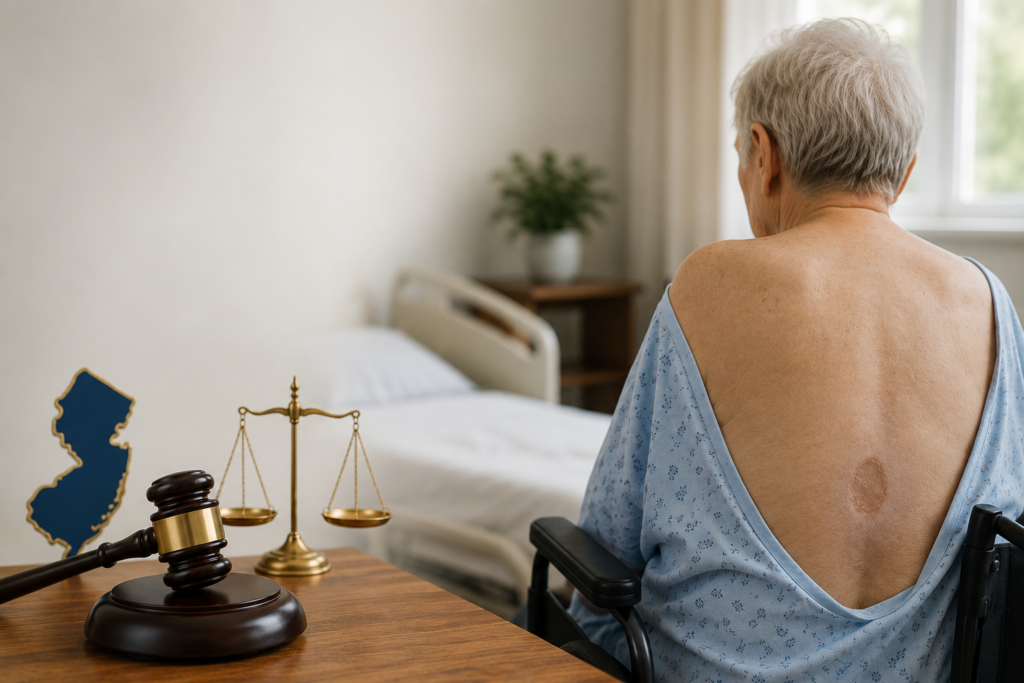
Bedsores are often an indicator that a resident may have received substandard care in a nursing home and are often preventable with proper care. If your loved one developed bedsores while a resident at a New Jersey nursing home, you may have a claim for nursing home negligence. The attorneys at Pellettieri Rabstein & Altman, a New Jersey law firm with over 90 years of experience, have represented families from all over the state in cases where their loved ones sustained injury as a result of nursing home negligence and worked to obtain the compensation that they deserve.
What Are Bedsores, and Why Do They Form?
Bedsores are another name for pressure wounds, which are localized wounds that can develop when pressure on the skin for a long period of time causes loss of blood flow to the skin and the underlying tissues.
Typically bedsores develop on bony areas of the body such as the heels, sacrum (base of the spine), hips, shoulder blades, and the back of the head. These wounds most commonly occur in immobile individuals who are bedridden.
Medical professionals classify pressure injuries into four stages:
- Stage 1 – Reddened, intact skin that does not blanch when pressed
- Stage 2 – Shallow open wound or blister involving partial skin loss
- Stage 3 – Full-thickness skin loss exposing underlying fat tissue
- Stage 4 – Deep wounds reaching bone, tendon, or muscle; can be life-threatening
Pressure injury prevention protocols such as turning and repositioning every two hours or more, use of appropriate pressure relieving mattresses, adequate nutrition and hydration management, and skin assessment are to be implemented in all nursing homes. A Stage III or IV pressure injury, or any pressure injury that is rapidly worsening is evidence of failure of basic care.
New Jersey Law Protects Nursing Home Residents
New Jersey has some of the strongest nursing home resident protection laws in the country. Several legal frameworks may support a bedsore claim:
The New Jersey Nursing Home Responsibilities and Rights of Residents Act (N.J.S.A. 30:13-1 et seq.)
The New Jersey laws governing the rights of long-term care residents are found in N.J.S.A. 30:13-1. Long-term care facilities are required to provide care that is treated with dignity, and meet the physical, social and psychological needs of their residents. A breach of the provisions of the act would form the basis for a civil lawsuit.
The legislative findings and declaration which define the well-being of its nursing home residents and set forth the responsibilities of the nursing homes and the bill of rights of the residents, were first codified in 1976, when N.J.S.A. 30:13-1 was enacted.
These rights were developed to protect patients in nursing homes from abuse and neglect. N.J.S.A. 30:13-1 also goes beyond the rights of patients by establishing the responsibilities of nursing homes. Furthermore, N.J.S.A. 30:13-4.2 shifts the costs and attorneys’ fees to the nursing home should it violate the provisions of the law.
Federal Nursing Home Reform Amendments (OBRA 1987) and CMS Regulations
Nursing homes in New Jersey that are federally certified (which is nearly all of the licensed facilities in the state) are subject to regulations of the Centers for Medicare & Medicaid Services (CMS). In particular, 42 C.F.R. § 483.25(b) requires that residents admitted to the facility without pressure sores are protected from development of such sores during their stay in the facility unless unavoidable. Violations of federal regulations can be used as evidence of negligence in a civil action in New Jersey courts.
Negligence claims can arise in long-term care settings when nursing home staff fail to meet the standard of care necessary to meet a patient’s physical, social and emotional needs. A facility can be found negligent and be held liable for harm to a resident, for example, when a preventable bedsore develops, or when an existing wound is not treated properly until it progresses to a worse stage of damage.
Nursing Home Oversight in New Jersey
There are hundreds of licensed nursing facilities in the State of New Jersey spread over 21 counties. The New Jersey Department of Health – Long-Term Care Licensure and Certification Program conducts annual surveys and also conducts investigation of complaints reported against nursing homes throughout the state. Some of the cities and towns in Mercer County, Essex County, Camden County, and Morris County have nursing homes which are licensed by the State of New Jersey.
Negligent treatment of patients at sub-optimal nursing homes, such as those located in Trenton, Cherry Hill, Nutley, Morristown, and Lawrence Township can be reported to the New Jersey Long-Term Care Ombudsman. The New Jersey Long-Term Care Ombudsman is the state-designated advocate for the residents of nursing homes.
Who Can Be Held Liable?
Liability for nursing home bedsore injuries can extend to:
- The nursing home where the resident developed the bedsores. The nursing home is the licensed operator of the facility where the resident resided.
- The parent company or management corporation that owns or operates the nursing home where the resident’s injuries occurred.
- Nurses and certified nursing aides (CNAs) – responsible for the care of specific residents.
- Treating physicians or wound care specialists that are employed by the facility or are independent contractors for the facility.
Many cases arise from understaffing at a facility, where the nursing home is operating to make a profit and are not hiring enough staff to provide the appropriate care to residents. As a result, individual nurses and certified nursing aides are spread too thin and are unable to perform their required duties of turning residents, completing skin assessments and providing wound care as needed. In these cases, New Jersey courts have allowed the plaintiff to sue the facility as well as the facility’s corporate owners.
What Damages Can You Recover?
A New Jersey nursing home bedsore lawsuit can be very successful and provide compensation for many things:
- Medical expenses – hospital admissions, wound care, surgery, rehabilitation, and infection treatment.
- Pain and suffering – the physical pain and suffering of the wounds as well as the mental distress and anxiety from the treatment of the wounds.
- Loss of quality of life – the resident has suffered and been impaired so that they are not able to perform the activities that they had been able to prior to the development of the pressure sore(s).
- Relocation costs – if you have to transfer your loved one to a better nursing home.
- Wrongful death damages if a resident passes away due to bedsore related complications such as sepsis.
- Punitive damages may also be awarded in the very few cases where a facility’s conduct is so egregious that it can be determined that they knowingly ignored a resident’s worsening skin breakdowns.
How Long Do You Have to File a Lawsuit in New Jersey?
N.J.S.A. 2A:14-2 sets forth a two year statute of limitations for the bringing of personal injury actions. For actions alleging negligence of a nursing home in the treatment of a bedsore, the statute of limitations generally runs from the date the bedsore was actually discovered or should have been discovered by exercise of reasonable care.
Don’t wait to contact an attorney. Evidence deteriorates, key witnesses are lost and nursing home documents can be altered or destroyed in a very short period of time. We encourage you to contact us as soon as possible to protect your rights.
Frequently Asked Questions
Q: Is a bedsore always evidence of nursing home negligence?
A: Unfortunately, no. Some pressure injuries are considered “clinically unavoidable.” These would be pressure injuries that developed on residents with severely compromised circulation, residents who are suffering from terminal illness, and other residents with other medical conditions that would prevent typical healing of tissue. In some instances, pressure injuries can develop on residents who were mobile upon admission to the nursing home and then develop a pressure injury for reasons that are deemed to be clinically unavoidable.
Q: Can I file a lawsuit if my loved one has passed away from bedsore complications?
A: Yes. If a resident of a nursing home dies as a result of complications from untreated or poorly managed bedsores (also known as pressure ulcers or wounds), including sepsis (a life-threatening disease caused by an infection), then a wrongful death claim can be filed by the estate of the decedent and by surviving family members. The claim for wrongful death seeks damages for the pain and suffering of the decedent as well as for medical expenses, funeral expenses and for the loss suffered by family members as a result of the decedent’s death. The time to file a wrongful death claim in New Jersey is two years from the date of death.
Q: How do I get the nursing home’s medical records for my loved one?
A: Residents and family members have the right to review all medical information regarding care of the resident. This includes all nursing notes, all wound care documentation, skin assessment logs, as well as information regarding staffing at the facility. If the facility is unwilling to provide such information, the family can obtain a copy of the resident’s complete medical record by requesting the same from the facility’s administrator or by having an attorney send a subpoena to the facility for such records.
Q: What happens if we signed an admission contract at the time our loved one was admitted to the nursing home that requires us to arbitrate any disputes rather than to litigate them in court?
A: Arbitration clauses, often referred to as pre-dispute arbitration agreements or forced arbitration, are a common practice found in nursing home contracts. These agreements are included in the admissions contract and require residents and/or their families to settle any disputes through private arbitration as opposed to going to court. In New Jersey, the use of such agreements has been scrutinized in several cases.
Q: How much does it cost to hire a nursing home abuse attorney in New Jersey?
A: Most nursing home negligence attorneys in New Jersey represent their clients on a contingency basis. That is, you pay nothing for their representation unless they recover an award of damages for you. Pellettieri Rabstein & Altman charges no fees or expenses in advance of work. They are paid a percentage of your award only if they are able to secure compensation for your injuries and related expenses.
Contact a New Jersey Nursing Home Abuse Lawyer Today
We have the experience and the resources to take on the large nursing home corporations that are hurting the elderly and disabled. Our attorneys have been fighting for the rights of New Jersey residents that have been injured for almost 100 years. Since 1929 Pellettieri Rabstein & Altman has obtained hundreds of millions of dollars in verdicts and settlements.
Our offices are located in Trenton, Cherry Hill, Morristown, Nutley, and Lawrence Township, New Jersey. If your loved one developed bedsores or experienced other neglect or abuse at a nursing home in New Jersey, please contact us for a free case consultation. No fees are charged unless we obtain a verdict or settlement for you.


