

Estimated reading time: 8 minutes
Table of contents
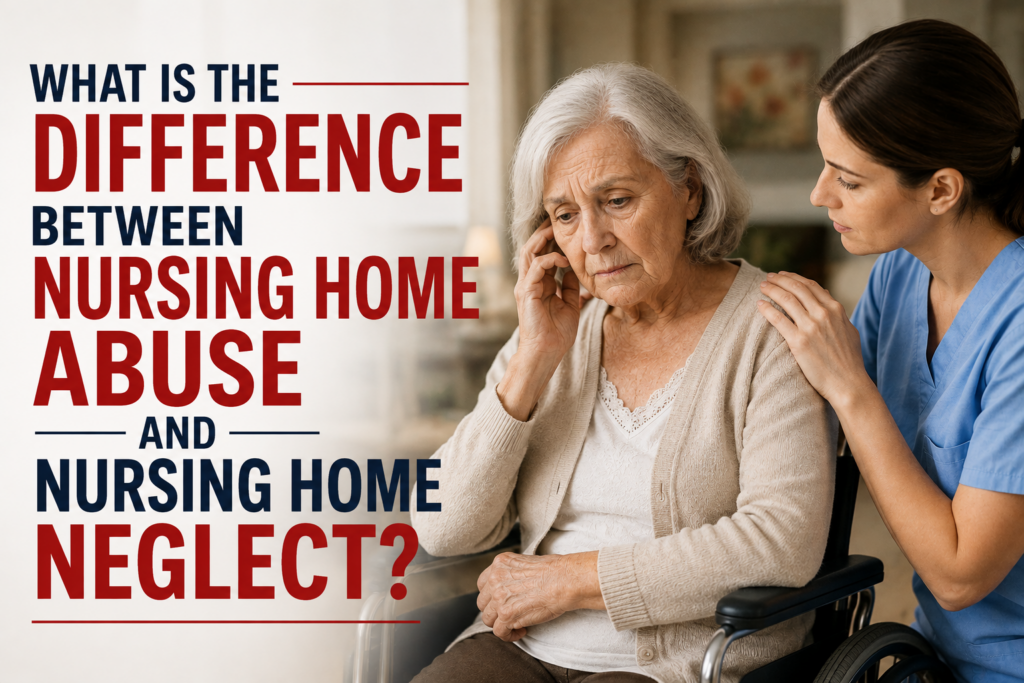
When a loved one is harmed in a long-term care facility, families often refer to what happened to their family member as abuse and/or neglect. When a resident of a long-term care facility is harmed, a family member wants and needs answers quickly. Pellettieri Rabstein & Altman has represented families of residents of long-term care facilities for decades in both instances of abuse and neglect. The distinction between these two terms determines the sort of evidence that will be necessary to prove a nursing home was at fault for harming a family member’s loved one and which parties can be held responsible for that harm.
Understanding Nursing Home Abuse
Nursing home abuse is intentional acts that cause physical, emotional, and/or psychological harm to residents of nursing homes. Most instances of harm are the result of some action which was intentionally directed to affect a resident negatively, physically, or to exploit them financially or in some other manner to treat them horribly.
- Physical abuse – hitting, restraining, or roughly handling a resident
- Emotional or psychological abuse – verbal threats, humiliation, isolation
- Sexual abuse – any non-consensual sexual contact
- Financial abuse/exploitation – theft, coerced changes to wills or accounts
- Chemical restraint abuse – sedating a resident without medical justification to make them easier to manage
Because abuse is intentional, it can carry both civil liability and criminal consequences for the individual staff member, in addition to negligence claims against the nursing facility for failing to screen, train, or supervise its staff.
Understanding Nursing Home Neglect
Nursing home neglect is different from nursing home abuse in that it is a failure to act on the part of a facility or a staff member to provide necessary care to a nursing home resident. In many cases of neglect, there is no intent to harm on the part of the facility or staff member, but rather an incident occurs as a result of neglect on the part of a facility or staff member that is caused by understaffing, lack of training, or cost cutting.
- Failure to reposition bedridden residents, leading to pressure sores (bedsores)
- Failure to provide adequate food, water, or medication
- Failure to assist with hygiene, leading to infections
- Failure to prevent falls or wandering
- Failure to monitor residents with dementia or cognitive decline
Neglect cases focus on whether the facility provided the proper care, normally proven through expert medical and/or nursing testimony as to the proper standards of care.
Key Differences at a Glance
- Nature of the act – Abuse generally involves intentional harmful conduct, while neglect generally involves a failure to provide necessary care.
- Typical causes – Abuse: malice, exploitation, poor hiring and supervision; Neglect: understaffing, poor training, cost-cutting.
- Legal theories – Abuse: intentional tort claims including negligent hiring and supervision. Neglect: negligence including corporate negligence and violations of statute.
- Common evidence – The evidence that supports claims of abuse is typically in the form of witness statements and/or written records of incidents that have occurred. Often, criminal records will also be introduced to support a claim of abuse. Neglect on the other hand is typically supported by medical records, staffing logs, the resident’s care plan and by expert testimony.
Nursing Home Abuse and Neglect Law in New Jersey
Additional protections afforded to the residents of nursing home facilities in the State of New Jersey, above and beyond negligence claims, are outlined below.
- The New Jersey Nursing Home Responsibilities and Rights of Residents Act (NHA), N.J.S.A. 30:13-1 to -19 allows for a private right of action by the resident for violation of his or her rights and allows for the recovery of attorney’s fees.
- Evidence from nursing home surveys and inspections, conducted by the New Jersey Department of Health, as well as complaints investigated by the department regarding long-term care facilities, can often form the basis of a nursing home abuse and neglect claim.
- The Office of the Long-Term Care Ombudsman investigates complaints on behalf of residents in long-term care facilities and can be a valuable early source of information for family members of residents of nursing homes and assisted living facilities.
- Statute of limitations: In most cases, a resident or family member has two years from the date of the injury (or date of discovery of the injury) to bring a personal injury or wrongful death action in New Jersey. However, there are certain exceptions, and thus it is wise to speak with a lawyer as soon as possible.
Our nursing home abuse lawyers practice in nursing home abuse law throughout Mercer, Middlesex, Burlington and Ocean counties, and represent clients in nursing home abuse and assisted living facility lawsuits throughout the state of New Jersey.
Recent Case Results
- Wrongful Death in Nursing Home: Our firm obtained a $750,000 settlement in a wrongful death case for the death of a resident who had been under the care of a New Jersey nursing home. The nursing home resident had been subjected to negligent medication deprivation prior to his death and the family was able to obtain a settlement prior to trial.
- Pressure Ulcer Claims: Our injury lawyers and wrongful death attorneys have secured nursing home pressure sore claims and inures in the amounts of $85,000 for a Stage II pressure sore, $150,000 to $200,000 for moderate Stage III pressure sores and up to $475,000 and a $450,000 recovery for the most serious of Stage IV bedsores that cause significant injury and harm.
- Infection cases: These types of cases involve untreated or poorly managed infections. Such cases arise from nursing home care failure in wound care or from nursing home failure in personal hygiene and typically result in a settlement to the resident and his or her family of $250,000 to $100,000.
- Inadequate Fall Prevention Protocols: Two nursing home fall cases resulted in the families receiving $225,000 and $150,000 respectively when their residents suffered serious fractures that could have been prevented with proper supervision and protective measures in the facility’s nursing home.
Frequently Asked Questions
Q: Is nursing home neglect the same as malpractice?
A: Not exactly. Nursing home neglect is often mischaracterized as malpractice. In reality, malpractice refers to the actions of a licensed healthcare provider (i.e. doctor) who failed to meet the required medical care. In the case of nursing home neglect, non-medical custodial care (i.e. bathing, dressing, etc.) is being neglected by non-medical staff. Of course, as with any facility, there are occasions when medical staff are involved in the neglect of a resident.
Q: Does the facility get held liable for the actions of one of its employees?
A: Yes. A facility can get held liable for the negligent hiring, training and supervision of employees who intentionally commit acts of abuse or neglect upon residents.
Q: What are the steps for reporting nursing home neglect or abuse?
A: First, document evidence of any abuse or neglect including photos of any injuries, and keep a log or record of dates and times when neglect or abuse occurs. Ask for a copy of the resident’s care plan and records. Report neglect or abuse to facility administrators and to NJ Department of Health, and speak with an experienced New Jersey nursing home neglect attorney.
Q: How long do I have to file a claim in New Jersey?
A: The time frame to file a nursing home neglect claim in New Jersey is generally two years from the date of the injury or date of discovery of the neglect. However, there are exceptions that may extend or shorten the time frame for filing a claim. It is therefore very important to contact a nursing home neglect attorney as soon as possible to protect the rights of family members of residents who have been abused or neglected.
Even if a Nursing Home is under investigation by the NJ Department of Health, a state investigation does not necessarily prevent a resident or family from pursuing a separate civil claim. These are two separate processes with different goals.
Q: What types of compensation will I receive for nursing home neglect?
A: Each case is different, however families of residents who have been abused or neglected can receive compensation for medical expenses, pain and suffering and in cases of death, wrongful death and survival action damages. Each case is unique and it is best to speak with an attorney about your specific situation.
Talk to a Nursing Home Neglect Attorney in NJ
If you suspect that a loved one is being abused or neglected in a New Jersey nursing home, you need to get the information and answers that you need as soon as possible. Unexplained bruises or wounds, sudden weight loss, bedsores, dehydration, and other changes in a resident’s physical or emotional condition can signal problems at a nursing home and indicate that a facility is not meeting its obligations of care.
Pellettieri Rabstein & Altman have been holding nursing homes, assisted living facilities and their staff accountable for their actions in New Jersey for decades. We will have the difficult conversation with the nursing home that your family trusted with the care of a loved one, such as a parent or grandparent. We investigate the nursing home’s staffing for example as well as their care plans and investigate past inspections of the facility. We work with medical and nursing experts to establish what standard of care is owed to your loved one and work to get our clients the compensation that they deserve for their injuries including past and future medical expenses as well as pain and suffering.
You don’t have to have all the answers. If something feels wrong, then talking to an attorney about the situation is the first step to finding out what is going on and what options are available to you and your family. Contact the nursing home abuse lawyers at Pellettieri Rabstein & Altman today for a free, confidential consultation.


